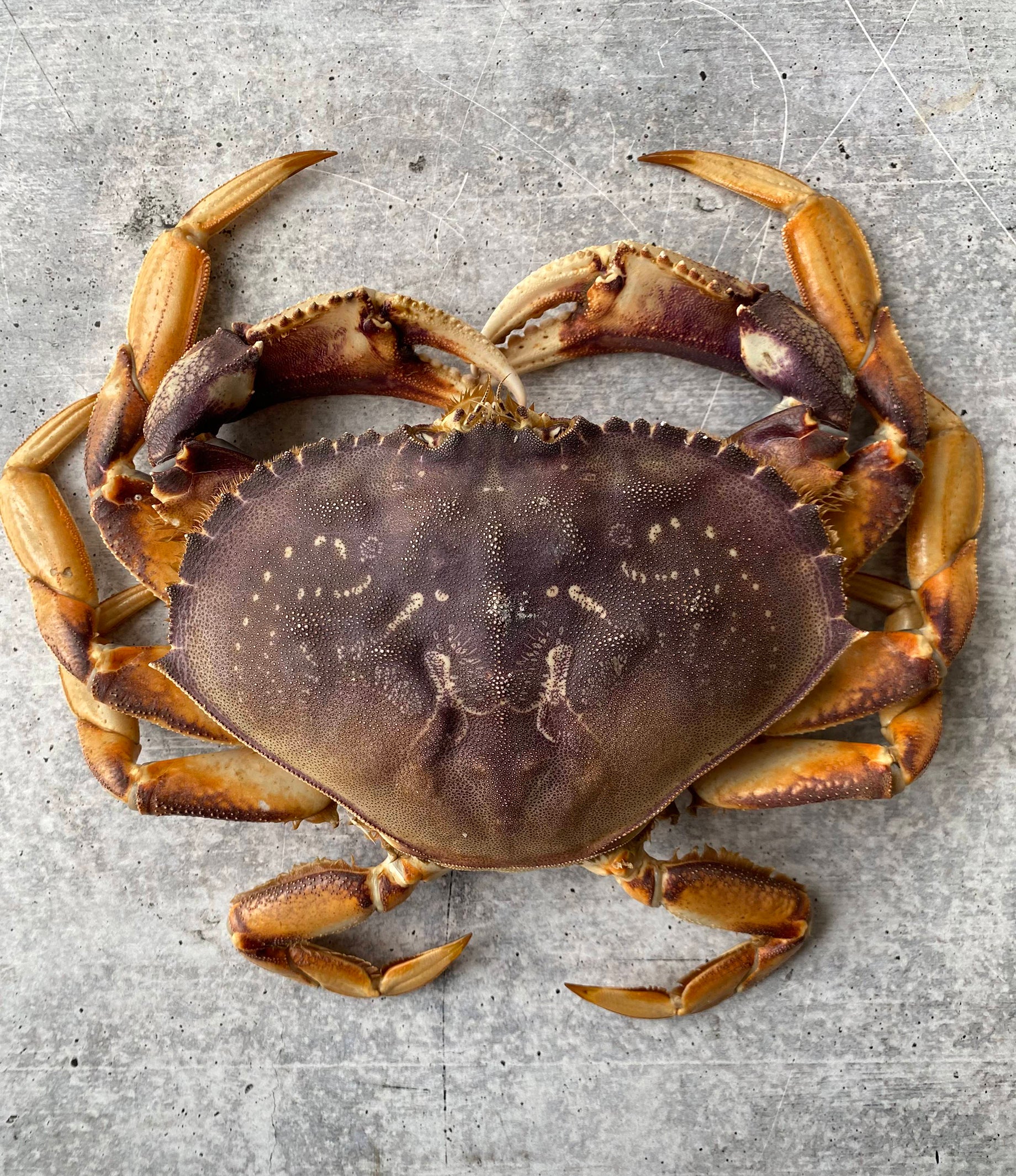
Dungeness Crab Info and Life
Cycle
From Wikipedia, the free
encyclopedia
The Dungeness crab (Metacarcinus magister) makes up
one of the most important seafood industries along the west coast of North America. Its typical
range extends from Alaska's Aleutian Islands to Point Conception, near Santa Barbara,
California. Dungeness typically grow 6–7 in (150–180 mm) at their widest point and inhabit
eelgrass beds and sandy bottoms. Its common name comes from the Dungeness Spit in the Strait of
Juan de Fuca, Washington state, United States,
which shelters a shallow bay inhabited by the crabs.
Description :
Dungeness crabs have four pairs of armored legs, two
claws, and a wide, hard shell. A Dungeness's legs are shorter compared to other
commercial crabs and their claws have a distinctive hook. The claws of the crab
are used both as defense and to tear apart large food items. The crab uses its
smaller appendages to pass the food particles into its mouth. Once inside the
crab's stomach, food is further digested by the "gastric mill", a collection of
tooth-like structures.[citation needed]
Crabs must periodically molt to grow; this process is
called ecdysis. Molting has the ability to regenerate lost limbs, although
they will be smaller the first molt after loss. During a molt, the shell
will separate where the carapace and abdomen meet. This allows the crab to exit
the old shell. Once outside the old shell the soft new shell will
fill with water and the crab will become 15-25% bigger than its original size.
During the first few weeks after molting, the crab
is very vulnerable due to the softness of its shell;
the shell will not fully harden for two months after molting. For
the first two years of a crab's life, it will molt six times a year. In
the third year, males molt twice and females molt once. After that, all
crabs will molt once a year, with females molting in the spring and males
molting in the summer. Dungeness typically live five years and measure 6–7
in (150–180 mm) at the end of their life. However, the crabs can live up
to eight years on the west coast of the US and have been seen to reach 13 years
in the northern reaches of their range. At these ages, maximum female size
can be up to 7 in (180 mm) and maximum male size up to 9 in (230 mm).
Dungeness crab prefers to eat clams, other
crustaceans, and small fish, but is also an effective scavenger. Their
scavenging habits can even lead them to eat other Dungeness.
A genetic analysis of adult Dungeness crabs indicated
that there is one population across the California Current System, but it is
likely that interannual variation in physical oceanographic conditions (such as
ocean circulation patterns) influence larval recruitment among regions, causing
genetic diversity to change through time.
Dungeness crabs aren’t picky
eaters! They’ll feast primarily on bivalves like clams and mussels, cracking
shells open with their powerful claws. You’ll find them hunting at night,
snagging small fish, worms, shrimp, and sometimes even their recently-molted
relatives. Adults prefer deeper waters with sandy bottoms, while juveniles hide
in eelgrass beds munching on smaller prey. Their diet changes seasonally,
adapting to what’s available—a fascinating glimpse into their opportunistic
survival strategy.
Dungeness crab have several pairs of appendages, which
they can regenerate if lost!
Life Cycle :
Two major molt cycles occur along the Oregon &
Washington coasts. Starting in April, and peaking in May and June, female
crabs will molt. It is at this time that mating between a hard-shelled
male and a newly- molted female takes place. (The males shed their shells later
in July and August). Mating occurs immediately
after the female has molted and before the new exoskeleton hardens. Males
are able to detect when females are molting, presumably through pheromones
although this is not confirmed yet. Each mating season, male crabs may
mate with many partners. Upon locating an available female, the male
initiates a protective premating embrace that lasts for several days. In this
embrace, the female is tucked underneath the male, oriented such that their
abdomens touch and their heads face each other. The sperm deposited by the
male is stored in the spermatheca and all sperm can be stored for up to two and
a half years. This means a female may choose to use older sperm or not to mate
at all during a given year.
Fertilization :
The females extrude the
fertilized eggs and hold them in specialized hair located on their adnominal tail flap.
Dungeness eggs are at first bright orange and darken as they develop. A
single female can hold up to 2 million eggs depending on her size; females that
use older sperm will carry fewer eggs. In the winter, a female crab will
bury herself in the sand and become inactive in order to protect her eggs.
Eggs typically hatch in the spring, although exact time varies with location.
When a crab is
ready to shed its shell, the top of the crab shell will separate from the bottom
shell along a “splitting-line” (near the edge of the underside of the shell),
the back raises up like a lid and the animal backs out of the old shell.
When the crab sheds its shell, they leave behind remnants of all the hard parts.
This includes the external covering of the legs, gills, eyestalks, and body.
During this process, the crab grows by taking in water and
expanding its new shell which is very soft and rubbery. Growth will continue for
several hours after shedding. During this soft shell stage, crabs are very
vulnerable so they will bury themselves in sand to hide from predators.
The new shell will become somewhat firm in 48 hours, but will
remain springy or flexible for several weeks. When crabs are in soft shelled
stages, they generally have lower meat yield and poor marginal quality.
Young crabs are free-swimming after hatching and are
diel vertical migrators that can be found at depths up to 80 ft (24 m) during
the day. The crabs go through five zoeal larval stages and one megalops
stage before settling to the bottom in their first juvenile stage. The
free-swimming stages typically take three months to four months, although in
Alaska crabs may remain larvae for up to a year. Sexual maturity is
reached after about 12 molts or two years. The crab's typical lifespan is
8-13 years.
Female crabs are considerably smaller, but have been measured
up to about 7 inches. A male crab is mature at about 3 years of age and 5 ½
inches in size. The yearly abundance of crabs fluctuates greatly, which is
mainly related to fluctuating environmental conditions.
Habitat and Range :
Dungeness are most often found in areas with
sandy bottoms but can be found on a wide variety of bottom types. The
crabs are found in high density from the intertidal zone to a depth of between
170 and 300 ft (52 and 91 m). Individual Dungeness have been found as deep
as 2,624 ft (800 m). Adult Dungeness require water with surface
temperatures ranging from 38–65 °F (3–18 °C) and salinity ranging from 11 to 35
practical salinity units (PSU). Larvae are much
more sensitive to such environmental conditions as
salinity and require temperatures of between 50 and 57 °F (10 and 14 °C).
Dungeness crabs move in and out of estuaries depending on
conditions such as tide, food availability, and the season. Tagging studies have
shown that most crabs stay in a fairly small home range, but a small percentage
make extensive migrations. The majority of Dungeness crabs will often leave
estuaries during periods of heavy rainfall and run-off, and may not return again
until salinity is again favorable.
In addition, large tidal exchanges produce strong currents which
cause crabs to bury themselves in the sand, becoming available to crabbing only
during slack tides.
The typical range of the Dungeness extends from
Alaska's Aleutian Islands to Point Conception, near Santa Barbara, California.
Occasionally, the crab can be found as far south as Magdalena Bay, Baja
California Sur, Mexico.
Fishery :
The Dungeness fishery was started by San Francisco
fishermen in 1848. By the early 1900s the fishery had expanded to match
the entire range of the crabs. Around this time regulations were put in
place to allow only hard-shelled male crabs that were at least 6 in (150 mm)
inches at their widest point. Similar regulations are still followed
today.
In all areas where Dungeness are fished a license is
required for harvest whether it is commercial or recreational.
Commercially in Oregon and Washington, a logbook that is to be turned in at the
end of the season is additionally required. Trip limits (how many crabs
someone can take in one day) and pot limits (how many pots someone can have in
the water at once) are set for both commercial and recreational crabbing in all
areas. In Washington state, bi-weekly crab condition testing occurs and if
the crabs are found to be too soft shelled, the limits will be reduced.
The crabbing season is generally open from November or December to late August
or early September. Crabbing is closed in the fall to protect soft-shelled
crabs.
Some recreational fishermen use crab rings or hoops to
harvest Dungeness. These hoops sit flat on the bottom and are pulled up
periodically, trapping any crabs in the hoop at the moment. Most crabs,
however, are caught in wire pots attached to a small buoy. Pots are baited
in the center and have one way door flaps for the crabs to enter through. Crab
pots in all regions are required to have biodegradable rot cord attaching the
pot and the buoy in case they are lost. Pots in Alaska are additionally
required to be made with biodegradable twine so that the pot will fall apart if
lost. In pots of all regions, escape rings are required to allow the escape of
undersized and female crabs.[4][9] In California, Oregon, and Washington these
are required to be 4.5 in (110 mm); in Alaska rings are required to be 4.38 in
(111 mm); in Canada they are required to be 4.1 in (105 mm). Pots are
typically set in waters 60–300 ft (18–91 m) deep.
The legal size of crabs is 6 1/4" (159 mm) in
California, Oregon, and Washington for commercial fisheries and 6.5 in (170 mm)
in Alaska and Canada. In recreational fisheries, the minimum size in
California and Oregon is 5.75 inches (146 mm), while Washington is 6 inches (150
mm). In Alaska, Washington, Oregon, and California (commercial) fisheries,
only male crabs are allowed to be harvested. Crabs typically reach legal
size at three to five years depending on location (Alaska has much slower
growth).
The Dungeness fishery has been closed in the Cook
Inlet, Alaska, since 1991; Yakutat, Alaska, and the Prince William Sound, Alaska
since 2000; and the southern region of the Puget Sound, Washington since 2018.
In Alaska, these closures are due to population decreases likely caused by
increased otter predation and environmental shifts. In Washington state,
the closures are due to population decreases caused by unknown factors.
Sustainability :
It is estimated that every season since 1970 the
fishery has taken 9-98% of the legal-sized male population with an average of
66% a year. The majority of this catch is caught in the first six weeks of
the season. Despite this, the fishery has had a stable mean catch for over
thirty years indicating populations are not overfished. This is likely due
to the regulations put in place that allow crabs at least one year of sexual
maturity before capture. Although 143 crabs are
thrown back for every 100 kept, the trapping and
subsequent throwing back of non-legal Dungeness does not seem to cause an
overabundance of harm to the population. Soft-shelled crabs have been shown to
have the highest mortality rates at just 9-25%.
Due to catch averages staying consistent, it is
assumed populations are healthy, but in reality very little is known about
Dungeness crab populations. In California, Alaska, and Washington,
research is minimal and information about populations is assumed from catch
records. In Canada, two out of seven crabbing areas are examined twice
every year. The other areas are studied inconsistently and usually in relation
to specific research questions. In Oregon, monitoring programs are in place for
mating success, genetic structure, population structure, and discard mortality.
The effect of the fishery on other species is
variable. The effects on benthic species and bycatch are relatively unknown,
although the effects are assumed to be negligible for both. In Alaska and Canada
there is no known effect on any other species. In Washington, Oregon, and
California, humpback whales are known to be highly affected with a high of 19
humpbacks entangled in crabbing line in 2016. In California, leatherback
turtles, orcas, and blue whales have also been known to be impacted. In recent
years entanglements of all species have increased; this is attributed to
increased reporting and changes in these species'
migration due to changes in prey abundance as a result of climate change.
It is important to note that entanglements are lower than they could be due to
the timing of the crabbing season: the first six weeks of the crabbing season
(when most fishing occurs) happens before the migration of many species. The
high seen in 2016 was likely due to a late opening of the season because of
toxic algal blooms.
Ghost crab ishing from lost equipment is a problem in
the industry, the scale of which is generally unknown. It is estimated that
10-20% of gear is lost each year with 7.5-32.5% of that ghost fishing.
Ghost crab fishing can entangle marine mammals, cause crab death, and harm the
ecosystem. Additionally, lost gear may ghost fish in places far from their
original spots due to currents and tides; buoys from lost pots in Oregon were
recovered four years later in the Hawaiian islands.
Overall, Seafood Watch has given the Dungeness crab a
sustainable seafood rating of "Good Alternative" meaning they are okay to buy
but be sure to be aware of potential concerns.
Culinary Use :
Dungeness crab ready to eat can usually be found at
most wharfs in coastal towns along the coast.
The Dungeness crab is considered a delicacy in the United States and Canada.
Long before the area was settled by Europeans, Indigenous peoples throughout the
crustacean's range had the crab as a traditional part of their diet and
harvested them every year at low tide. The flesh has what is considered to
be a delicate flavor and slightly sweet taste. Today they are an integral
part of the cuisines of California, British Columbia, and the Pacific Northwest
and traditionally feature in dishes like crab Louie or cioppino.
About one-quarter of the crab's weight is meat.
Dungeness crabs can typically be purchased either live or cooked. A humane way
to kill a live crab is to: (1) stun the crab by submerging it in ice water for
several minutes, (2) flip the crab onto its back, and (3) drive the tip of a
small pick about an inch below the center of its mouth. However, many cook live
crabs by simply dropping them into boiling salt water. The crab then is
allowed to cook for 15 minutes, after which time the crabs are removed and
placed into cold water to cool and then cleaned. Cleaning the crab consists of
removing the shell, scooping out the gills and
intestines, and separating the legs and claws from the body. When removing the
shell there will be a yellow substance, called crab fat or crab mustard (which
is not fat, but actually the hepatopancreas) and is used in many dishes.
Another method of preparing crab is called half-backing. Half-backing is
done by flipping the crab upside down and chopping it in half (from head to
"tail"), after which the guts and gills can be scooped or hosed out. Many
consider half-backing to be superior to cooking the entire crab, because the
meat is not
contaminated by the flavor or toxins of the guts.
Half-backed crabs boil faster or can be quickly steamed instead of boiled.
Some common tools for removing crab meat from the shell are a crab cracker and a
shrimp fork. others simply use the last joint of the second leg as a pick.
Threat :
In some areas adult Dungeness crabs can be found in or
near estuaries. The hyposaline conditions of the estuaries are lethal to some of
the crab's symbionts, such as Carcinonemertes errans which consumes a brooding
female's live eggs. Dungeness crabs surveyed in Coos Bay were less likely to be
infected by C. errans and have fewer worms present on their carapace when
inhabiting less saline waters farther inland.
A 2020 study funded by NOAA showed that larval crabs
are being affected by ocean acidification. Another potential harm related
to global warming is red tides.
Another threat to the Dungeness crab is an invasive
species called the European green crab (Carcinus maenas..) The green crab
outcompetes the Dungeness Crab for food and habitat.
Celebrations of the Dungeness Crab :
In 2009, after lobbying from school children at Sunset
Primary School in West Linn, Oregon, and citing its importance to the Oregon
economy, the Oregon Legislative Assembly designated the Dungeness crab as the
state crustacean of Oregon.[25] In 2024, California governor Gavin Newsom signed
legislation designating the Dungeness crab as California's official state
crustacean. The 2022-23 crab season brought revenue of about $54.4 million to
the California economy.
The annual Dungeness Crab Festival are held in Port
Angeles, and Westport Washington, to name a few.
And from the Alaska Fish and Game
Dungeness Crab:
The
Dungeness crab (Cancer magister) is a popular shellfish that inhabits bays,
estuaries, and the nearshore coast of Alaska. The
Dungeness crab is named after one of its
representative habitats-a shallow, sandy bay inside of
Dungeness Spit on the south shore of the
Straits of Juan de Fuca. It is widely distributed,
however, and can be found as far north as Cook
Inlet and Prince William Sound and south to Magdalena
Bay, Mexico. This crab supports both a
commercial fishery and a personal use fishery in
Alaska.
Dungeness crabs are related to shrimp, lobster, and
other crabs. The Dungeness crab has a broad,
oval body covered by a hard chitinous shell. It has
four pairs of walking legs and a pair of claws.
This species can be distinguished from other
commercially important crabs (king and Tanner crabs)
because its legs are much smaller and shorter in
relation to its body size and it has no spines on
the top side of its carapace (shell).
Reproduction and life History:
Dungeness crabs mate from spring through the fall. The male crabs are
polygamous--each male crab may mate with more than one
female crab. This may be an important factor
in maintaining the reproductive viability of this
species because only male crabs can be harvested
in commercial and personal use fisheries.
Male crabs mate only with female crabs that have just
molted (shed their old exoskeleton).
Fertilization of the egg does not occur at the time of
mating. The female crab stores the sperm
until her eggs are fully developed. The eggs are
fertilized when the female extrudes them under her
abdomen where they are carried until hatching. A large
female crab can carry 2.5 million eggs. After
hatching, the young crabs are planktonic and swim
freely away from the female. Larval development
takes from 4 months to as long as a year in Alaska.
Six successive stages (5 zoea and 1 megalopa) occur
before the crabs molt into the first juvenile
stage. These crabs grow each time they molt. During
the first two years both sexes grow at similar
rates but after two years the female crabs grow more
slowly than the males. Sexual maturity may be
reached at three years. At 4 to 5 years of age, a
Dungeness crab can be over 6 1/2 inches in shell
width and weigh between 2 and 3 pounds.
A large male Dungeness crab can exceed 10 inches in
shell width. The estimated maximum life span of
this crab is between 8 and 13 years. Dungeness crabs
are widely distributed subtidally and prefer a
sandy or muddy bottom in salt water. However, they are
tolerant of salinity changes and can be found
in estuarine environments.
The crab are generally in waters shallower than 15
fathoms, but they have been found in depths down
to 100 fathoms. Dungeness crabs foraging behavior
coincides with their habitat. These crabs scavenge
along the sea floor for organisms that live partly or
completely buried in the sand. They are
carnivores, and their diet can include shrimp,
mussels, small crabs, clams, and worms.
Commercial Fishing:
The
Alaska Fishery and Fur Seal Industries publication made the first historical
reference to the Alaska Dungeness crab fishery in
1916. This crab was first commercially canned at
Seldovia in 1920. Today, Dungeness crab is processed
by shorebased processors, catcher processors,
and floating processors. The crab are sold whole or in
sections as a fresh or frozen product.
Dungeness crabs are often caught by commercial fishers
in circular pots typically baited with
herring, squid, or clams. Pots are usually about 40
inches in diameter and 14 inches high. They are
constructed of 3/4-inch round, steel frames wrapped in
rubber tubing then covered with stainless
steel wire mesh woven in 2-inch squares. Two 4-3/8"
diameter escape rings are required to be built
in each pot to keep the pot from filling with
undersize crabs. The number of pots that can be set by
a vessel and the fishing season varies by management
area in Alaska.
Throughout Alaska, only hardshell male Dungeness crabs
over 6 1/2 inches in shell width may be
harvested.
The sex of a Dungeness crab can be determined by
examining the abdomen: the abdominal flap of a
female crab is about 1 1/2 times as long as it is wide
and has a much broader base than a male crab
which has an abdominal flap generally twice as long as
it is wide.
Personal use: Residents of Alaska may harvest
Dungeness crabs for personal use. This fishery is
often incidental to recreational boat outings. Crab
pots similar to those used in the commercial
fishery, ring nets, diving gear, dip nets, and hooked
or hookless handlines can all be used to
harvest crab for personal use.
Dungeness crabs are sometimes stranded by minus tides
and can be picked up by an observant
beachcomber. Be forewarned, the mighty pincers of this
crab can move quickly and catch you unaware!
Personal use anglers fish at depths between 3 and 20
fathoms where more "keepers," male crabs
greater than 6 1/2 inches wide, seem to be found. They
usually bait their pots with the most
convenient bait, fresh fish carcasses. The number of
crabs that can be kept varies from 5 to 20 per
person, depending on the area fished. To take more
than you can use is a waste and a shame, because
the Dungeness crab is one of the grand fringe benefits
of coastal Alaska.
Cooking crab:
Dungeness crabs are usually boiled for approximately 20 minutes. As a cautionary
note,
paralytic shellfish poisoning (PSP) has been found in
the internal organs of Dungeness crab,
therefore, do not eat the internal organs including
the "crab butter" (hepatopancreas). Where or
when the toxin is found is unpredictable, but high
levels have been found throughout Alaska in
Dungeness crab. Take this one precaution and continue
to enjoy one of Alaska's tastiest seafoods.
Text: This article is a composite of WDWF, ODFW and ADF&G
information