|
|
Safety on
the Water / Recovery |
Be Prepared ; As the skipper you really need to do a orientation session before leaving the dock if you have any new passengers aboard. Along with it being a CYA situation, it is really to acquaint your passengers for the day on where your life saving devices are, how to wear them along with the other many things (some small) that they may need to know if things start going downhill fast. Where is the bilge pump switch? Which VHF radio frequency do you normal stay on and what is the US Coast Guard's frequency? If they are contacted, they will want your boat ID number. Write it down next to the radio. Where are the throw cushion/rings? Where are your bumpers/fenders kept? Where is the boat hook stored? Where is your intended fishing area? When do you expect to return? Who watches for floating debris or crab pot buoys? If you have a watch person, explain to them how to call out a location to you, like the hour hands of a clock, (floating log coming up at 9 O'clock) and at what distance becomes critical? Direct them to not move around in a small boat while under weigh as this shifts the balance and can be devastating at the wrong time. Put on your inflatable PFD before you leave the shore/dock.
You may be called upon to assist a person that is in the water. You as a skipper need to think ahead, what do you need to carry on your boat, or do, to be able to assist in any type of water recovery that you might be called upon to do? The size of your vessel will also determine how you carry out this process as a 14' skiff will be a lot different than a 20' or even larger boat that may have a rear door to a near water level platform. Do you try to recover the person over the gunnel or move to the stern? You do not want to capsize your boat while trying to recover someone else, which puts you both in jeopardy. Do not put yourself in danger, either water conditions or limitations of the recovery boat itself. At times, it could even be advantageous to bring the person alongside and motor slowly to a safer location to do the recovery.
Good communications of everyone onboard is essential, shout out what you are doing and or want done. This lets the in the water person AND your crew know what is being done and how to react.
It is best to keep a tidy ship. Do not leave a lot of fishing gear laying around, so when you are finished using it, stow it. Keep your tackle boxes stored in locations where they are not underfoot. Keep the spare rods stored out of the way. Crab pots stored and secured best possible. If someone falls overboard, YOU do not want to stumble at the wrong time during this recovery and you also go into the water.
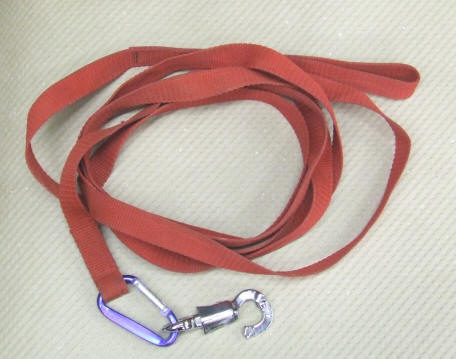
Initially my own thoughts were more leaning toward me falling overboard as I often fish alone. With this in mind, I have made up a 1" Nylon tether strap about 10' long with loop on one end and a quick release snap on the other end. My inflatable floatation vest is an offshore version with harness straps and Dee rings in front that I snap the strap snap into while attaching the other end to the boat. This 10' distance gives me enough length to move around in the boat.
| Tether |
 |
But, what if you come upon someone else in the water? Do you have a plan on how to get them safely into your boat? If they have been in the water very long, they may not have enough energy to assist you in pulling them in, even if you have a helper this my be a chore. It is much different in assisting a active person in who can at least help some, than a very exhausted person, especially one who is of any large size at all.
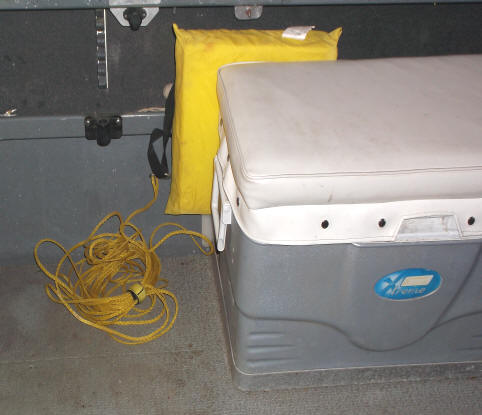
All sport boats are required to have a throwable device onboard which could be a cushion or ring. Attached to this needs to be a recovery rope (which is not required) it is recommended that it be at least 50' long as seen in the photo on the left below. This cushion's home is stuffed between the back of the cooler and the inside of the boat. Illustrated here the rope is out in the open, normally it is It is stuffed behind at 180 degrees shown.
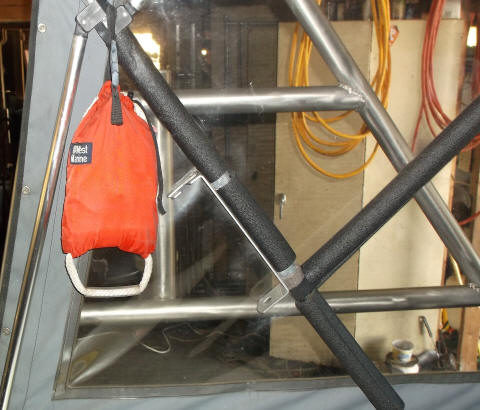
It is also recommended to have a throw bag onboard in a readily accessible location utilizing a quick disconnect buckle as seen in the right hand photo below. For those of you who do not know what a throw bag is, it is a small bag with a built in hand grips on both ends, containing a small float and about 50' rope. The end of the rope that is not stuffed into the bag has a loop on it's exposed end. This loop is for the thrower to slip their hand into and retain it on their wrist, retaining that end, and holding onto the attached hand grip, do the throwing. It is designed to be thrown underhand like pitching horseshoes ,and the rope unravels as it goes out. The recipient can then grab the floating grip of the bag, and can then be pulled in.
Another thing to use if the person is closer and that all salmon fishing boats have on board, is a landing net. These provide enough gripping area for those in the water to not easily miss.
| Throwable yellow cushion | Throw bag |
 |
 |
Be sure that all of your deck ropes float (some don't). If for some reason none of these may be used in a water recovery and when thrown out, it sinks, that does not help moral.
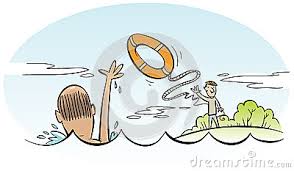
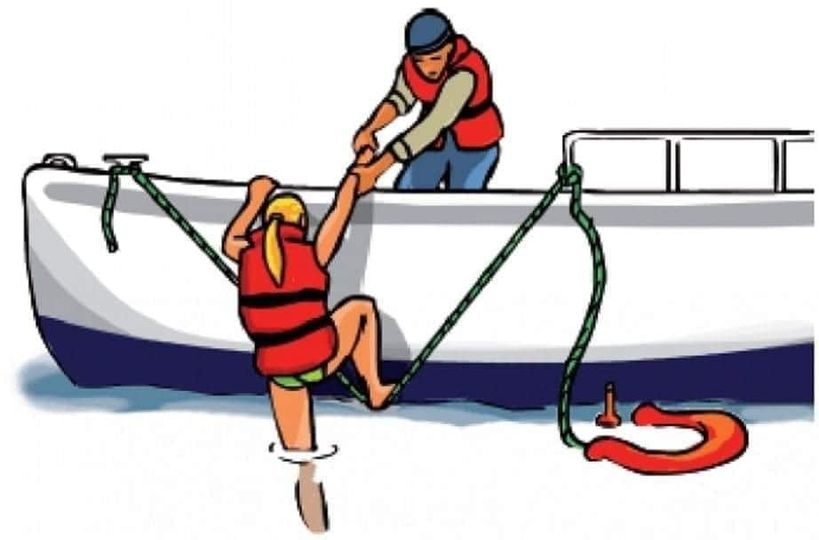
As seen in the illustration below, this simple method will assist the person aboard IF they have the ability to help you..
 |
Options ; If your boat is large enough and you have a power operated crab/shrimp pot puller, you may consider making a 2" wide Nylon web sling with eyes sewn in both ends and 6' long, that can be utilized to slip over the persons upper body and under their arms which may allow you to assist in lifting them out of the water. Here the looped ends are snapped into a LARGE D type Karabiner snap, which also gives a handhold for either the rescuer or the one in the water.
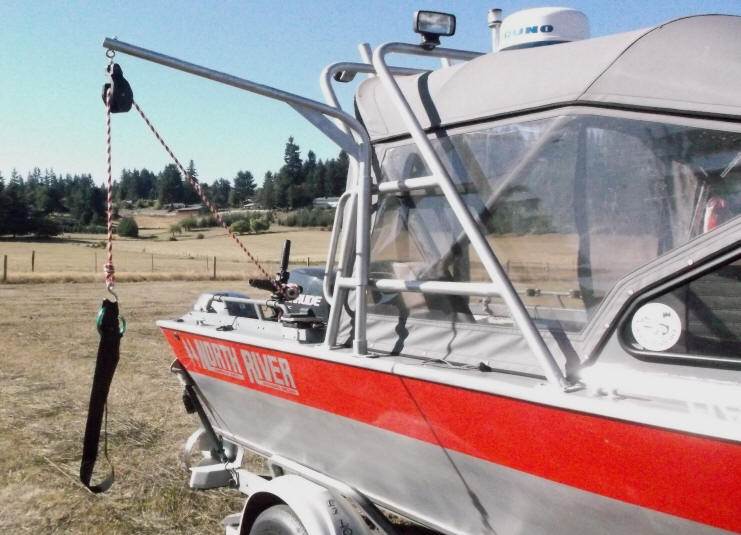
Even if you can only have just a davit (hand powered) like the one shown in the photo below, it is a whole lot easier to pull the rope down than up.
| hand powered pot puller used as a recovery aid |
 |
There is also a commercial safety ladder available that is in a bag attachable to a railing, that has a jerk cord that drops a rope type ladder into the water. This is sold by Cabelas online for about $60.
Or if your plan is to bring them in over the transom
if you have one side open, then consider building a shelf over your sonar
transducers and making it stiff enough to function as a step. In addition
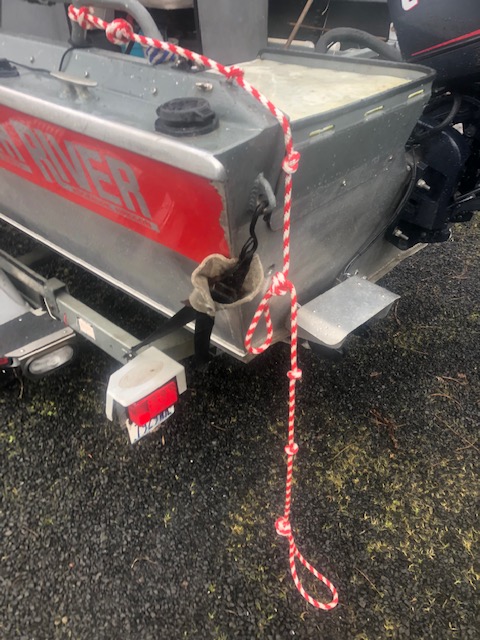
to this tie off a 1/2" nylon rope so that it drags in the water off the outside
of that stern side. Tie knots in it at about 6" intervals so that it can
be used to assist hand holds from slipping in conjunction to the previous
mentioned step so if YOU
go overboard while alone. In actuality on my boat, it is not deployed
unless I am fishing alone, or if we would be in the process of a rescue type
recovery.
If you have an outboard motor that has power tilt, if they can get
to where they can climb onto the cavitation plate, the power tilt can lift them
higher, which will help immensly.
|
Here is a metal deflector over the transducers diverting water spray away from the motor. It is also reinforced enough to make it usable for a step that may be used to help an overboard person regain entry into the boat. |
|
|
Do not go in the water to rescue a person, unless
there is someone to rescue you and then only with a tether attached to yourself.
Carry a change of clothes and wool blanket or two onboard to use after you have them aboard. However it may be best if you store them inside a sealed plastic bag/
Take a First Aid class, and have a fully stocked First Aid kit onboard. Learn to evaluate/recognize a hypothermia effected person.
Be Prepared ;
The one thing that needs to be drilled into every
boater/s brain is PREFENTION. As a skipper, train yourself to always be
vigilant, NEVER let yourself become complacent. As that is the time when
bad things can happen, and when they do it could be almost
Instantaneous, which could be deadly. This could be simply calling
it a day if the weather worsens, or slowing down in your speed. The other
thing is to insist that all your passengers wear life preservers at all times
when on the water.
I have lucked out as in my 75 years on the water, I have never
encountered any life threatening situations. I am not afraid of the
water, but am very respectful of it's capabilities. I have learned
how to read the clouds, weather and to interpret weather forecasts.
I have canceled a day on the water because of what I saw/sensed. And
have even misread a blue hole in the sky and wished I had never left the dock
that day.
I have been near enough to bad situations for someone else to
understand accidents, making poor choices in relationship to weather, poor
seamanship, and just being in the wrong place at the wrong time.
From this I will relay one "boating accident" below.
Columbia
River Boat Collision, August 2025
Randy's
20’ aluminum fishing boat was involved in a on the water boating accident August
22, 2025 at about 2 PM on the Columbia River near Longview Washington.
He was trolling downstream in the middle of the river at the speed of about 2
MPH, below the mouth of the Cowlitz River nearing the Longview shipping docks.
They were virtually alone (no other boats
within 150 yards) as compared to upstream at the mouth of the Cowlitz River,
which was nearing bumper boats.
Aboard
with him were friends Rick and Dan. Rich had just reeled in to clean weeds
off his gear, so was preoccupied. Both passengers were standing on
the Starboard side with Rich beside that stationary swivel seat, but facing away. Dan
was standing immediately behind him. And Randy was at the stern operating the
trolling motor.
Dan heard/saw/another boat fast
approaching from the front Port side, (left) He started yelling, with
Randy joining in. Randy observed the other boat (another 20’ aluminum
boat) bearing down on them FAST from about a 10 O’clock position,
Randy said the other boat’s bow was so high that he could not see any persons
aboard it, meaning the boat was not trimmed (possibly too many passengers
rearward) so it would have been plowing water.
When Rick looked up he remembers only
seeing the
bottom of the boat going over him. This boat hit them so hard and fast that
it flew over Randy’s boat sliding rearward and exiting at about a 4 O’clock
position. The bottom of the other boat crushed Rick against the forward
facing Starboard seat. As it went over them Dan was knocked into the
water, being hit on the head in the process.
The other boat after going completely
over Randy’s boat then moved across the river on the Washington side for a
considerable length of time. He later came back to the launch as Randy was
preparing to leave, only asked about Randy’s passengers, and what year Randy’s
boat was, as his was the same make/model, and left. Randy informed him
that both passengers were airlifted to the hospital.
Randy came out without a scratch (but
many "What IF" memories), as the other boat went over his boat just ahead of were
he was standing, but he dove onto the deck as the other boat flew over.
Rich was on the floor and had collapsed being unconscious,
bleeding profusely. Dan was in the water on the Port side, with no
life presser on as things happened too fast. Randy was trying to
maneuver the boat to retrieve Dan and yet not get him in the trolling motors
propeller. To compound the issue Randy was recovering from double
shoulder surgery and had not enough strength to pull Dan onboard.
Another fishing boat immediately came to
the rescue, pulling Dan out of the water. Aboard this other fishing
boat was a trauma center doctor, who came aboard and administered immediate
first aid (which probably saved Rick’s life) as Randy headed back to the boat
launch.
Phone calls were made and both passengers
were airlifted to PeaceHealth St. John Medical Center in Longview. Rick
had a fractured skull, a broken nose, his right clavicle was busted in five
places, which required plates to be installed. Along with, he had seven broken
ribs, but three of them were broken in multiple places, and a punctured lung,
which required a drain tube be installed, along with a laceration to his kidney.
Obviously he was heavily medicated after surgery.
Dan suffered a concussion from the
collision.
Randy is highly disturbed at the
Cowlitz County Deputy Johnston who listed this collision as just a bad accident.
The other boat operator was negligent for one, hit and run for another and has
made no effort to contact Randy or his lawyer at any time. According to the
local newspaper, no citation was issued by CCSD ? Randy did
talk to a Sheriff Dept. supervisor expressing his displeasure and that the
other skipper needs to be accountable for his actions.
Things are still way
up in the air and nothing done 3 months later. And Randy has recently
found out the investigating office did not issue a citation to the other
skipper at the time of the "accident", however just over 3 months later Randy
learned that CCSD has written a citation to the other skipper. This has
probably came about because of insurance companies pushing the CCSD to really
look at the happenings and that negligence was involved on the other skippers
part, in that up until now Rick's, own insurance company has footed the hospital
bills, however his coverage is diminishing fast. He sees legal
action will have to be involved, but has had to change lawyers, because the
first one was a relative of a relative, but was not doing anything.
Randy’s insurance agent says the boat itself is
totaled.
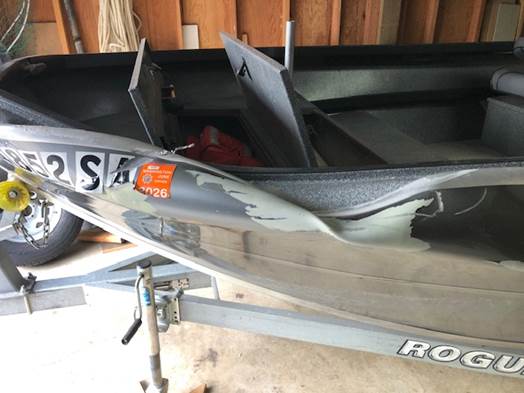
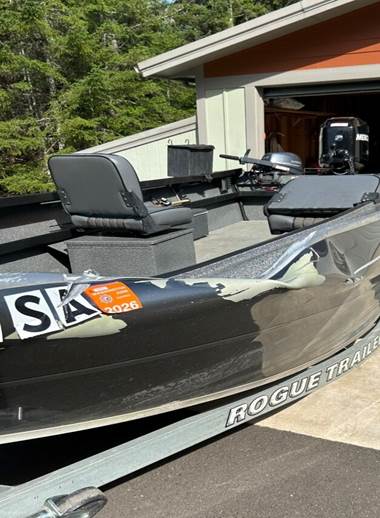
| Here you see the side that the other boat initially hit, which then slid rearward |
 |
|
Here another
view looking more to the rear at about the same angle the other boat
would have taken and the far seat which Rick was crushed onto (the
seat at that time would have been turned around & facing forward) |
 |
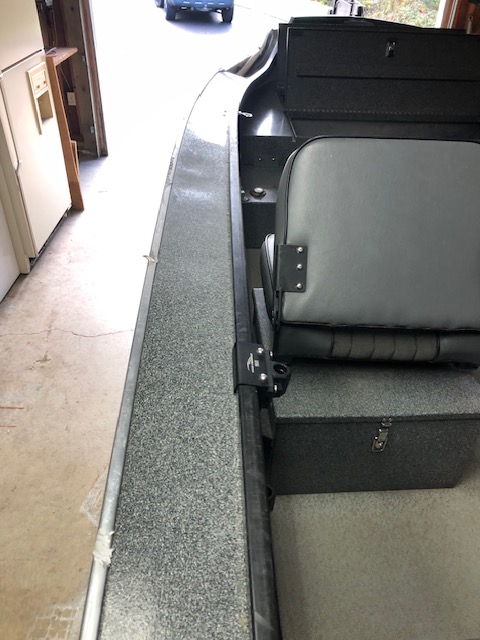
| Below you can see the DEEP scratch marks on the Port gunnel where the other boat’s chine/keel drug (about the middle of the seat to rearward in the foreground), along with the caved in Port gunnel of the initial hit |
 |
From this I see two observations that would not have prevented this "accident", but that may have helped the man in the water. (1) wear a self-inflating life vest at all times. (2) have a throwable life preserver readily available.
This Page Under Construction
Copyright © 2015 - 2026 LeeRoy Wisner All Rights Reserved
Back to the Main Ramblings Page
Originated 06-20-2015, Last updated
02-18-2026
contact the author